 Download Online Help
 Print
|
|
|
|
|


GSE Engineering Compliance, Schedule Tab
The Schedule tab allows the user to define a schedule (or time limits) for the E/C.
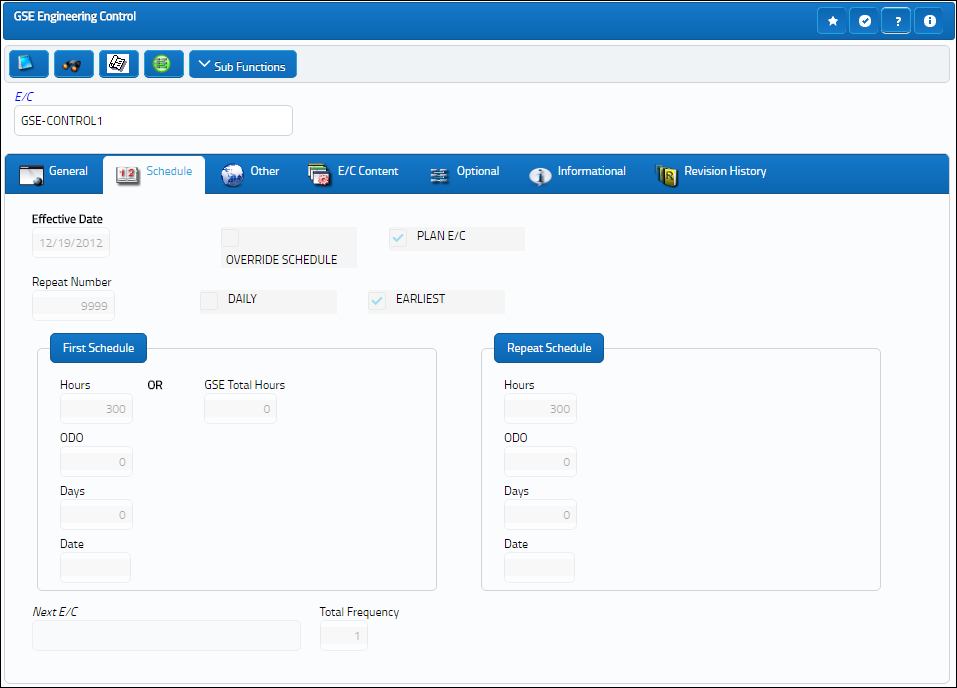
The following options/information is available in this window:
_________________________________________________________________________
Effective Date
Entered as the date from which the user requires to track time on the E/C being set up unless a Total Schedule has been defined. Once the effective date is entered and the A/C or P/N Effectivity for the E/C is applied, changing the effective date on this Tab will not change the effective dates on each individual aircraft or component that the E/C is effective to. Either the Effectivity will need to be removed and re-applied, or the effective date field will need to be changed individually in the Effectivity Override window for each tail number or component.
Note: If the effective date is greater than the current date, planning will not forecast for this E/C until the effective date has been met.
Reset Date button
Select the Reset Date button to reset the effective dates for items not previously complied with and/or not overridden. The following window will appear upon resetting the effective dates:
If the E/C only becomes effective following completion of another E/C or is part of a cycle of E/Cs (such as Next E/Cs A-Check1, A-Check2, etc.), then the effective date MUST be set to 00/00/0000. Based on the Effective Date, the system determines the aircraft actuals hours and cycles from that date forward. Any accumulation of flight times prior to the effective date will not be applied against the E/Cs schedule.
Override Schedule checkbox
The Override Schedule checkbox will display as checked when an Override Schedule has been activated for the E/C. The Override  button allows an alternate schedule to be activated for this E/C once a specific set of criteria is met. The alternate schedule can be applied against either the First Schedule or the Repeat Schedule of the E/C. For more information, please refer to the Override button via the Engineering Control, Schedule Tab.
Note: For date controlled E/Cs, the actual date of compliance will be changed to the Work Order's date once the Work Order is closed.
Plan E/C checkbox
The Plan E/C checkbox must be selected for the E/C to appear in the A/C Planning Query option. If de-selected, the E/C will not appear in the A/C Planning Query. This checkbox may be de-selected in the event that the user does not want to plan for an E/C that is a known daily occurrence and allows for more flexibility in planning convenience items verses mandatory items. For additional information regarding the effects of the utilization of this checkbox, refer to Viewing the E/C via the A/C Planning Query.
Note: This will default to being selected.
Repeat Number
The number of occasions the E/C will be repeated. If the Repeat Number is set to 1, the E/C is a one time only E/C and only the First Schedule is applicable. If the Repeat Number is set to 9999, the E/C will be carried out on the First Schedule 1 time and then the Repeat Schedule indefinitely.
If the Repeat Number is a specific number, such as 5, the E/C will be carried out on the First Schedule 1 time and then be repeated 4 times according to the parameters configured on the Repeat Schedule (and then terminated).
Note: If the Repeat Number is set to 1, the Redo checkbox appears.
Daily checkbox
When the Daily checkbox is selected, actual hour/cycles (time) are reset and a compliance record is written for this E/C upon the completion of the Task Cards on an 'Open' Work Order rather than at the closing of the W/O. This feature is useful for the scheduling of recurrent daily E/Cs. When selected the Auto Reschedule checkbox appears.
Note: The First and Repeat Schedule Days field on the (Schedule Tab) must be set to 1 for proper functioning of Daily E/C compliance.
Earliest checkbox
The Earliest checkbox option is selected if the E/C Schedule parameters are to be planned at the earliest occurrence. For the latest occurrence, this option should not be selected. By selecting the Earliest checkbox, the schedule will be determined by which occurrence comes first; Hours, Cycles, or Days.
First Schedule section (Hours/ODO/Days)
The First Schedule is the parameter and threshold for the initial occurrence and compliance of the E/C, as some E/Cs may have multiple schedules. The First Schedule only takes effect if there is no previous compliance against the E/C. The Effective Date Based Schedule is the initial Schedule Hours/ ODO/ Days threshold parameter for this E/C. The Hours/ ODO/ Days are being calculated based on the effective date of the E/C. The system will default to the Earliest occurrence of these parameters, unless the Earliest flag is unchecked, then it will be the latest occurrence.
GSE Total Hours
First Schedule Date
The initial Schedule Date limit (due date) on this E/C. For example, an AD might have a NLT (No Later Than) Date for the First Schedule of the E/C.
Repeat Schedule section
If the E/C has a Repeat Number greater than 1, then the Repeat Schedule is the parameter for the subsequent repetitive occurrences of the E/C for repeat compliance requirements. As with the First Schedule, some E/Cs may have multiple schedules. When an E/C has multiple schedules, the Earliest checkbox is pivotal in the configuration as the E/C may call for the compliance to be accomplished at the latest occurrence. The First Schedule information must be entered in order for the Repeat Schedule to be applicable.
Repeat Schedule Hours/ODO/Days
The Repeat Schedule Hours/ODO/Days threshold parameter for this E/C (If applicable). The system will default to the Earliest occurrence of these parameters, unless the Earliest flag is unchecked, then it will be the latest occurrence.
Repeat Schedule Date
The Repeat Schedule Date limit (due date) on this E/C. This is most common for an initial inspection and a follow up inspection.
Next E/C
This field is used to form a dependence between a phase group of E/Cs used to set up checks that will automatically follow each other. For example, if the user has four phases for the K-Check; phases K1 through K4 and each has it's own requirements. They may be set up individually and linked in chronological order using this field. The system can move from K1 to K2 automatically following completion of K1. A user may verify the Next E/C order by selecting on the Next E/C  button to the right of the field.
Once E/C K1 is complied with, the E/C K1 completion date will become the effective date for E/C K2 (the system will automatically populate the Effective Date for the aircraft tail number). The most recently complied E/Cs effective date (K1) will return to 00/00/0000 upon it's compliance. With the example of checks, the user must also remember to keep the repeat number at 9999, so the cycle will continue. To set up this functionality, the Effective Date must be set to 00/00/0000. The current E/C to be carried out will have its effective date set, which then returns to 00/00/0000 upon compliance.
Note: It is important to select the the current phase of the Next E/C when deferring a defect.
Total Frequency
The total number of 'phases' included in this E/C. This field works in conjunction with the Schedule Control Tab. The Schedule Control Tab is a preferred method of creating complex relationships between E/Cs and their scheduling, which can make an E/Cs occurrence dependent on another E/Cs schedule. The benefit of this is that it eliminates the need for the Next E/C option (K1, K2, K3, K4, etc.).
_________________________________________________________________________
Download Online Help
Print
|
©1997-2018 Trax USA Corp. All rights reserved. This manual may not be copied, photocopied, reproduced, translated, or converted to any electronic or machine-readable form, in whole or in part, without prior written approval from Trax USA Corp. |
 |