
 Share
Share
 Print
Print
|
|
|
|
|


The Called On Repeat and Called On 1st controls are meant to be used together, where an E/C is activated by one E/C (Called On 1st) and then repeated on another E/C (Called On Repeat).
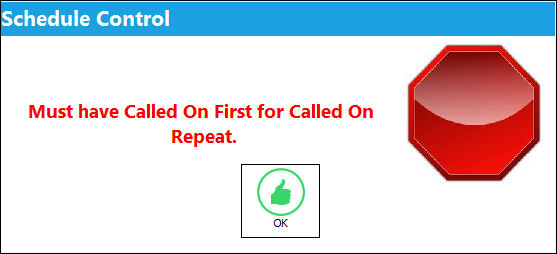
The E/C must have a Called On 1st control before the system allows the user to create a Called On Repeat control. Once the child E/C is complied with via the compliance of the Called On 1st parent E/C, it will start its relationship with the Called On Repeat parent E/C. For more information on the Called On 1st control, refer to Called On 1st, via Engineering Control Schedule Control Tab.
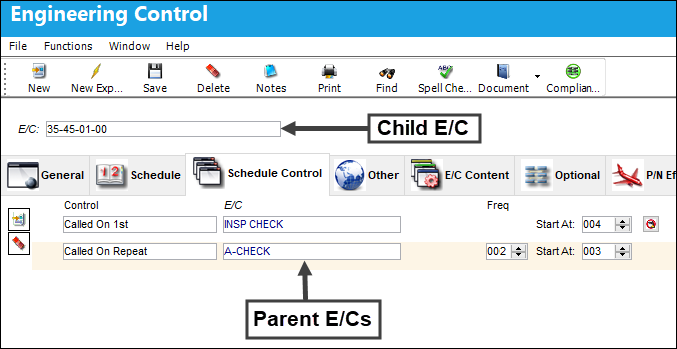
If the Called On Repeat parent E/C is complied with before the Called On 1st parent E/C, the child E/C will not receive a compliance record; the Called On 1st parent E/C must be performed for the child E/C to receive initial compliance to trigger its relationship with the Called On Repeat parent E/C.
This control can only be utilized once per E/C.
The following information/options are available in this window:
_____________________________________________________________________________________
Freq (Frequency)
The frequency number indicates the interval the child E/C is to be called on to the parent E/C. For example, if the frequency number is 2, every second time the parent E/C is added to a work order the child E/C will follow.
Start At
The Start At number indicates at which parent E/C compliance (Completed NO) the child E/C should be called on to receive compliance.
 If the Called On Repeat parent E/C gets complied with before the Called On 1st parent E/C, and the Called On Repeat parent E/Cs Completed No. now surpasses the Start At number, when the Called On 1st parent E/C eventually gets complied with to trigger and activate the Called On Repeat relationship, the child E/C will ignore that the Called On Repeat Start At number and be called on the parent E/C at the next applicable frequency.
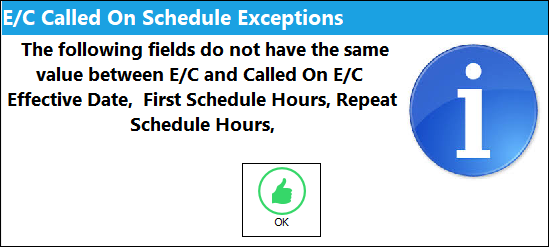
E/C Called On Schedule Exceptions  button
Indicates that there are differences between the child E/C and parent E/C schedules. When the button is selected the system displays the E/C Called On Schedule Exceptions popup window displaying the fields where the schedule values are different.
_____________________________________________________________________________________
If the user attempts to create a Called On Repeat control before a Called On 1st control has been entered the following warning will appear:
Called On 1st / Called On Repeat example:
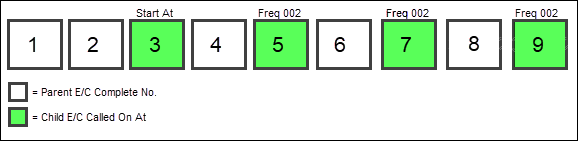
Using the above parent/child E/C relationships, the child E/C should initially be called on to the Called On 1st parent E/C at its 4th compliance (Start At = 4). The Called On 1st compliance triggers the child E/C to start its relationship with the Called On Repeat control where the child E/C is called on onto the Called On Repeat parent E/C at its 3rd compliance (Start At = 3), and then repeat every second occurrence afterwards (Freq = 2).
The Called On 1st parent E/C has received compliance 3 times for A/C 777.
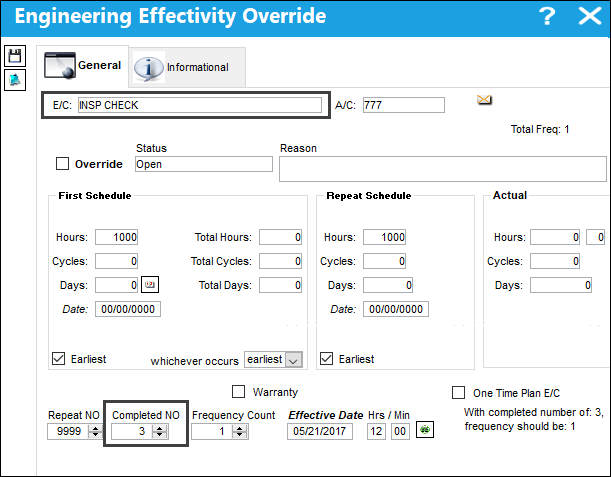
The child E/C has not yet been complied with for A/C 777.
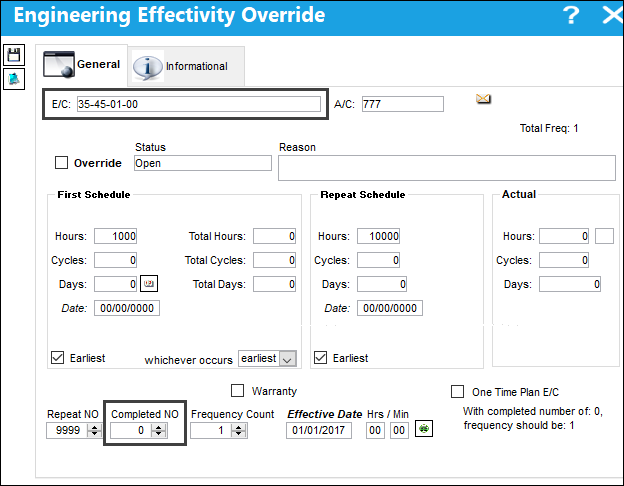
Upon the Called On 1st parent E/C's 4th compliance the child E/C is called on.
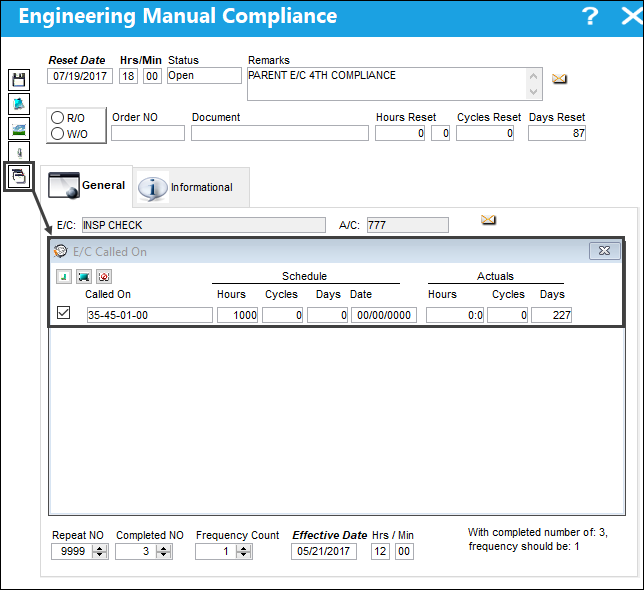
The parent E/C receives its 4th compliance for A/C 777.
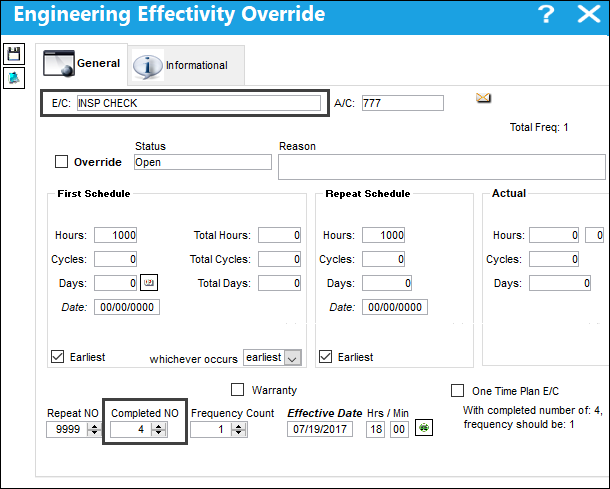
And the child E/C, called onto the parent E/C's 4th compliance, has also been complied with for A/C 777.
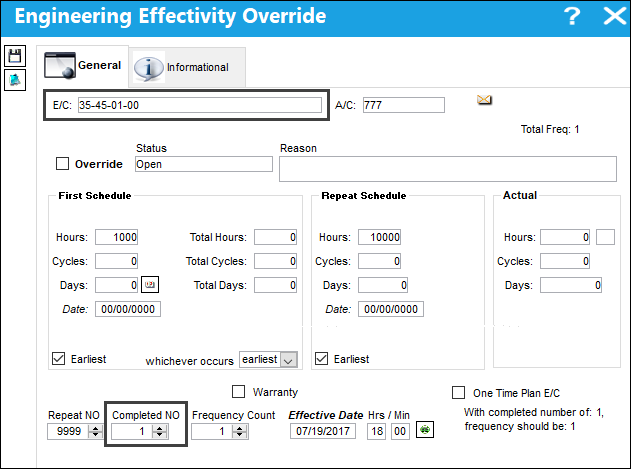
The child E/C's compliance (driven by the compliance of the Called On 1st parent E/C) triggers the called on relationship with the Called On Repeat parent E/C for A/C 777.
Using the parent/child E/C relationship above for the Called On Repeat control, the parent E/C has a Start At = 3 and Freq = 2. The Called On Repeat parent E/C will receive compliance 2 times and then upon its 3rd compliance the child E/C will be called on; the child E/C will then continue to be called on the Called On Repeat parent E/C every second occurrence.
The Called On Repeat parent E/C is complied with 2 times on A/C 777.
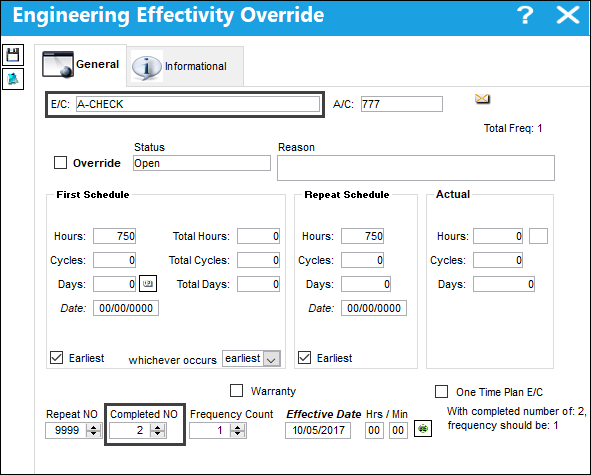
Upon the Called On Repeat parent E/C's 3rd compliance the child E/C is called on.
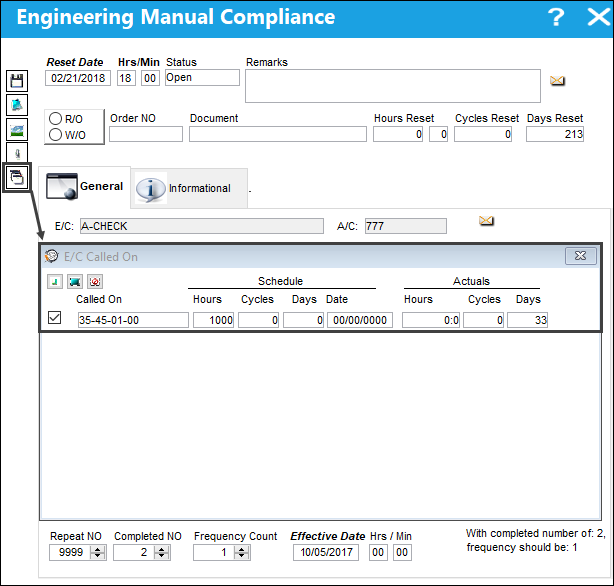
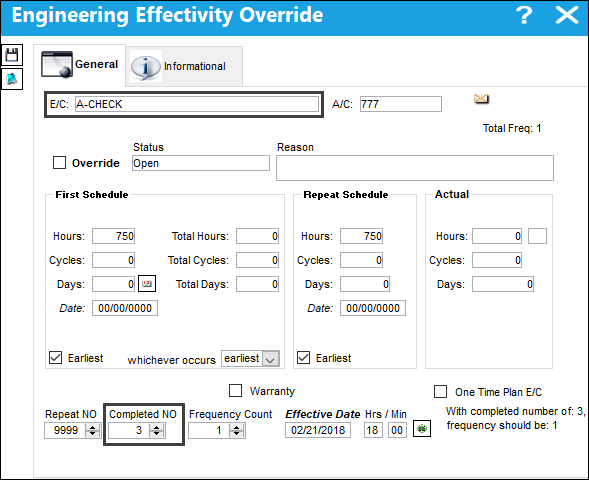
The Called On Repeat parent E/C receives its 3rd compliance for A/C 777.
And the child E/C, called onto the parent E/C's 3rd compliance, has also been complied with for A/C 777.
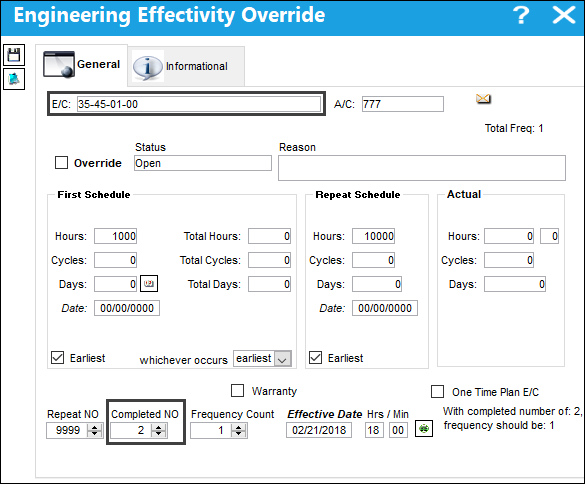
When the parent E/C is complied with the 4th time for A/C 777, notice the child E/C will not be called on.
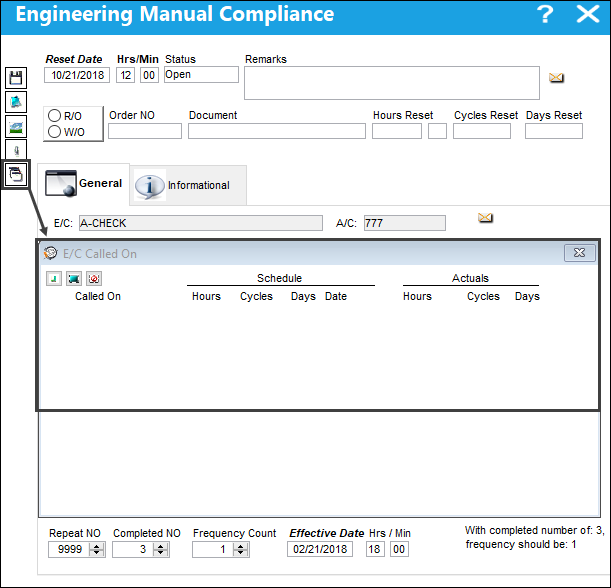
When the parent E/C is complied with the 5th time for A/C 777, notice the child E/C is called on.
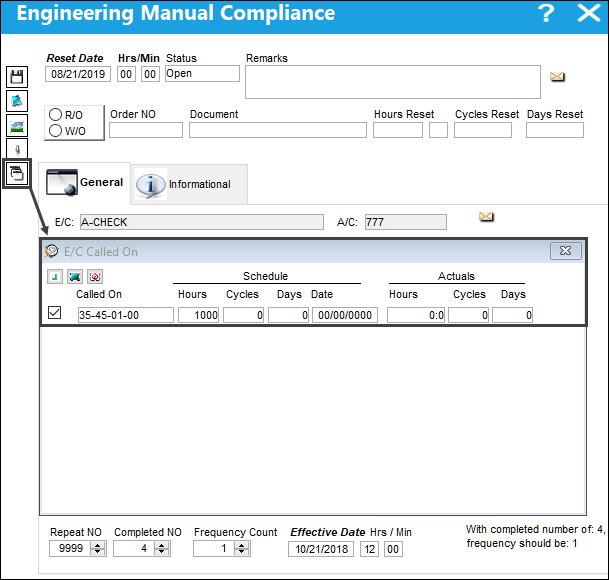
And the child E/C receives its 3rd compliance for A/C 777.
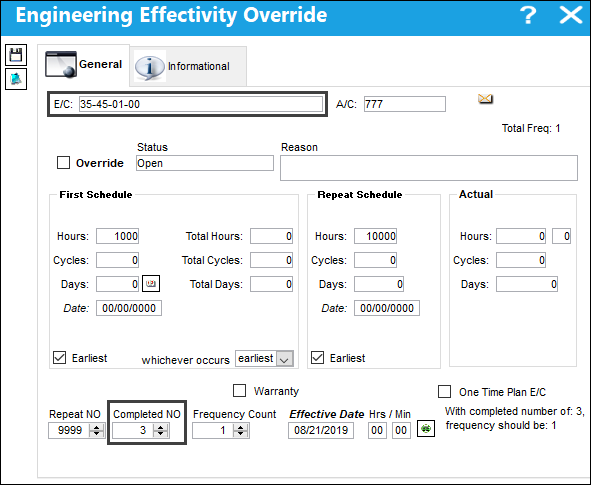
The child E/C will continue to be called on every second occurrence of the parent E/C.
Share
Print
|
©1997-2026 Trax USA Corp. All rights reserved. This manual may not be copied, photocopied, reproduced, translated, or converted to any electronic or machine-readable form, in whole or in part, without prior written approval from Trax USA Corp. |
 |