
 Share
Share
 Print
Print
|
|
|
|
|


Spec2000 XML Specifications, General Tab
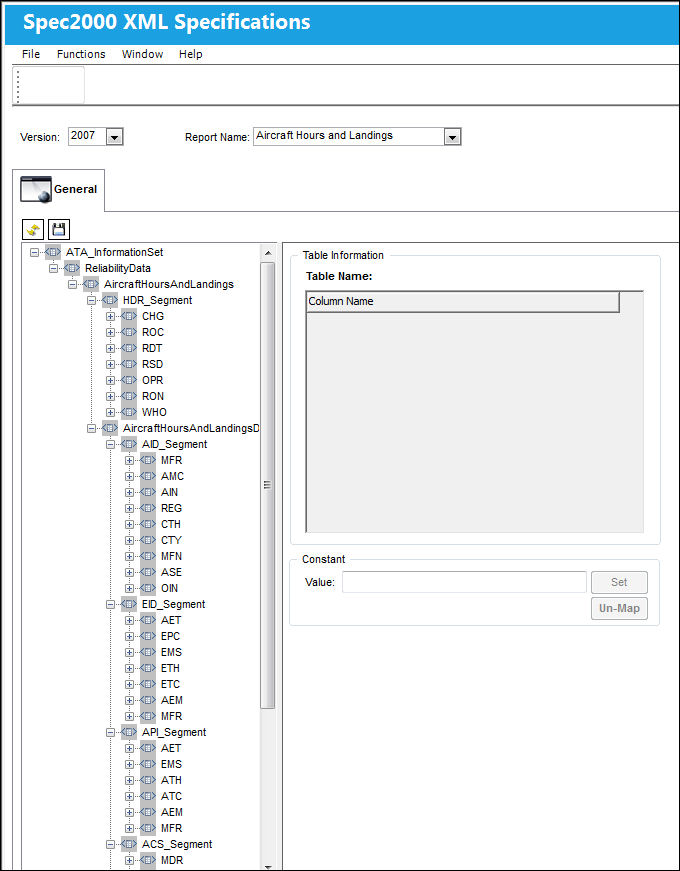
TRAX will display the Spec2000 XML Specifications Window as shown below:
Select desired Report from the Report Name drop down menu. The reports will generate in the left column of the window. Select a file node (i.e. RON) and double click on the field to be used (i.e. PROFILE_MASTER).
TRAX will display the following additional fields:
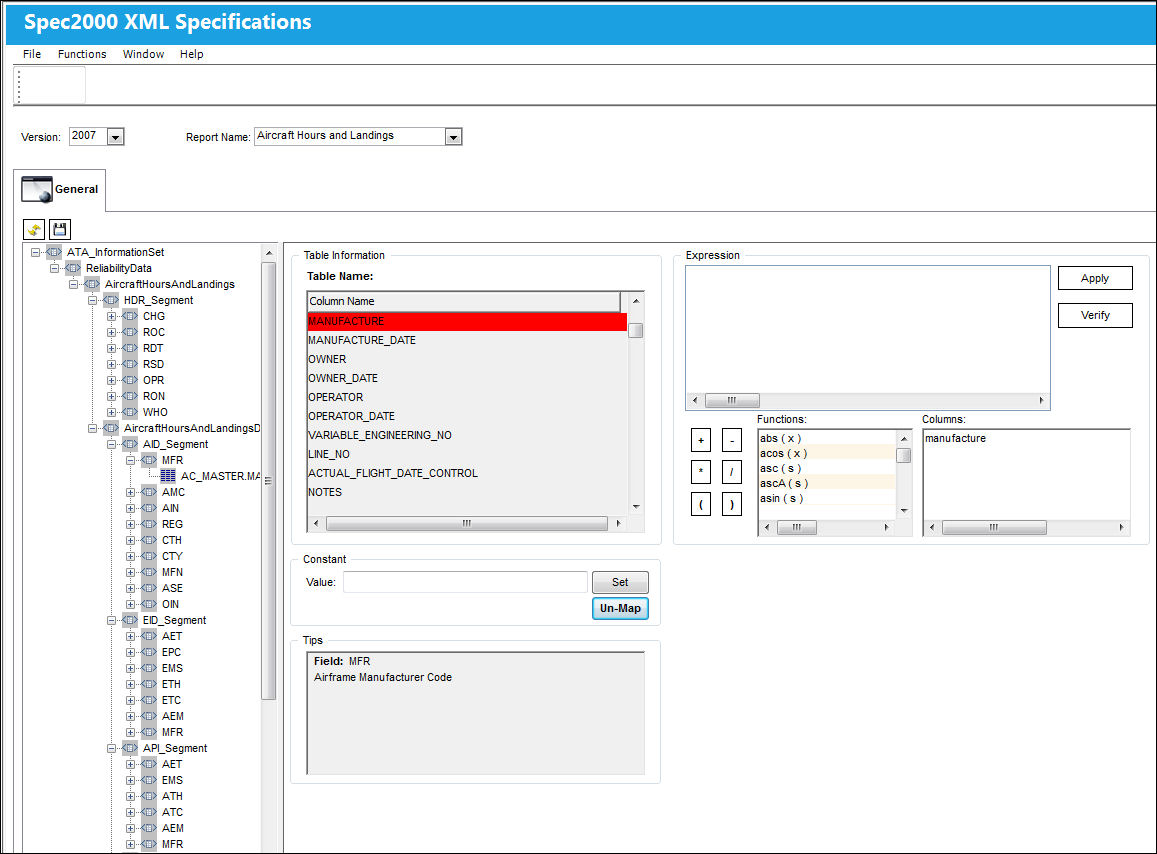
The following information/options are available in this window:
_____________________________________________________________________________________
Version drop down
The Spec2000 version.
Report Name
This option allows the user to select the Spec2000 Chapter 11 Schema with all of the fields required to be mapped to the TRAX tables and columns.
Aircraft Hours and Landings - This record is for detailing the total and monthly flight hours and cycles of an operator’s fleet. It is for the purpose of calculating fleet utilization, hour/cycle ratios and reliability measures such as Mean Time Between Unscheduled Removals (MTBUR), Mean Time Between Failure (MTBF), etc. This record is also used to report aircraft short-term out-of-service. It is to be completed by an aircraft operator.
TRAX term = A/C Actual Flights.
Aircraft Logbook Record - This record is for collecting aircraft Technical Logbook, Maintenance Logbook and Cabin Logbook data. It is to be completed by the aircraft operator or third party maintenance provider. Key fields will link the Logbook Record to the Aircraft Event Record, LRU Removal Record and the Scheduled Maintenance Record.
TRAX term = Defect Reports.
Aircraft Schedule Maintenance Record - This record is for collecting aircraft scheduled maintenance visit data. It is to be completed by an aircraft operator or a third party maintenance provider. Key fields will link the Aircraft Scheduled Maintenance Record to the Logbook Record, the LRU Removal Record and the Service Bulletin/Modification Record.
TRAX term = Work Order, Compliance, Non-Routines.
Aircraft Status Change Record - This record is for collecting and exchanging aircraft changes in ownership, registration number, engine type and aircraft operator. This record is also used to report long-term aircraft out-of-service. It is to be completed by both the aircraft receiving organization and the aircraft releasing organization. Engine type changes are to be reported by the aircraft operator.
TRAX term = Registration Change.
Aircraft Event Record - This record is for collecting aircraft technical incidents as well as delay, cancelation, air or ground turnbacks and aircraft diversions data. It is to be completed by an aircraft operator or third party maintenance provider. Key fields will link the Aircraft Event Record to the Aircraft Logbook Record and LRU Removal Record.
TRAX term = Defect Report.
LRU Removal Record - This record is for collecting LRU removal data identified by part number, serial number, Commercial And Government Entity (CAGE) code as well as the aircraft from which it was removed and the details surrounding why the LRU needed to be removed. It is to be completed by an aircraft operator, third party repair facility or whoever is removing the component. Key fields will link the LRU Removal Record to the Shop Finding Record and the Aircraft Event Record.
TRAX term = A/C P/N Transaction.
Piece Part Record - This record is for collecting and exchanging information about Shop Replaceable Units (SRU’s) and other piece parts associated with a shop received LRU. Key fields will link the Piece Part Record to the Shop Finding Record.
Service Bulletin - This record is for collecting information on the incorporation of service bulletins, other modifications such as Supplemental Type Certificates and Airworthiness Directives when included with a Service Bulletin. Airworthiness Directives not accompanied by a Service Bulletin will only be collected in the Logbook record. This record is to be completed by the aircraft operator or the third party maintenance provider that incorporated the bulletins. Key fields will link the Service Bulletin/Modification Record to the Aircraft Scheduled Maintenance Record and the Logbook Record.
TRAX term = Engineering Control and Engineering Compliance.
Shop Findings Record - This record is for collecting and exchanging LRU shop repair/teardown findings. It is to be completed by an aircraft operator’s repair shop, third party repair facility or original equipment manufacturer for the purpose of detailing the findings associated with an LRU that enters a shop. The Shop Findings Record is also used to collect Shop Replaceable Units (SRU’s) and other piece parts associated with the shop received LRU. Key fields will link the LRU Removal Record to the Shop Finding Record.
TRAX term = Tear down Reports.
Summary Data - This record is for collecting summarized rate and count information on an operator’s fleet. It is to be completed by the aircraft operator or third party maintenance provider.
TRAX terms = TRAX Record Incidents, Delays, and Cancelations of Defect Reports.
Table Name
This option allows the user to map the TRAX tables and fields to the Spec2000 chapter 11 schema.
Expression
This field is used to build expressions.
Select the Verify button to verify that the expression is correct. Select the Apply button to apply an expression.
Functions
This field contains a list of functions that can be applied to an expression.
Columns
Selected values will appear in this field (i.e. company_name).
Constant Value
This option allows the user to define a constant value for data that is continuous.
Tips
This option provides basic Spec2000 chapter 11 field definitions for the end user.
_____________________________________________________________________________________
Share
Print
|
©1997-2026 Trax USA Corp. All rights reserved. This manual may not be copied, photocopied, reproduced, translated, or converted to any electronic or machine-readable form, in whole or in part, without prior written approval from Trax USA Corp. |
 |