 Download Online Help
 Print
|
|
|
|
|


The following is an example of Engineering Compliance against an aircraft:
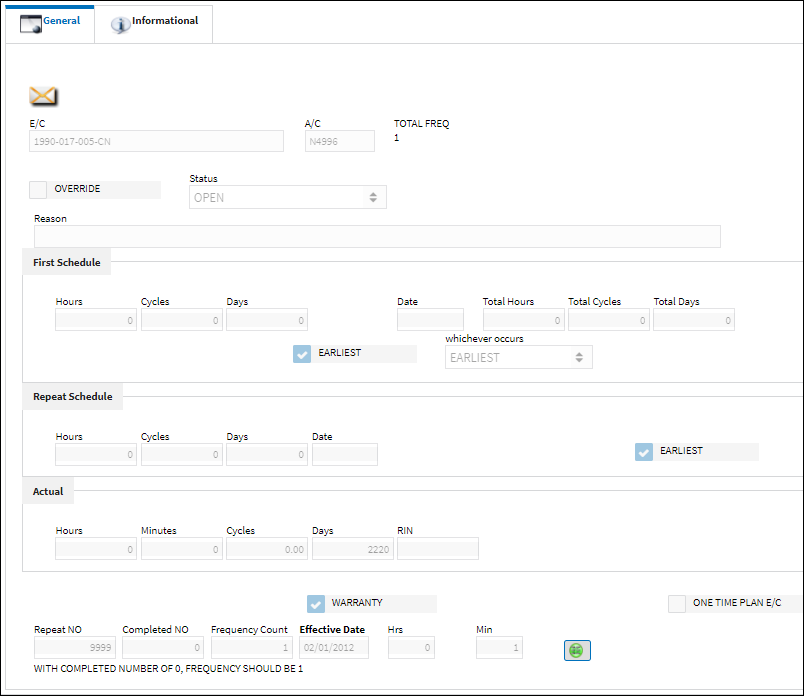
The following options/information is available in this window:
_________________________________________________________________________
E/C
The Engineering Control that specifies aircraft or component scheduled maintenance intervals.
A/C
The Aircraft registration number. All items within this window will only pertain to this A/C and may not match the default blanket schedule on the Engineering Control, Schedule Tab due to override information added.
Total Freq
The total number of 'phases' included in this E/C. This field works in conjunction with the Schedule Control Tab. The Schedule Control Tab is a preferred method of creating complex relationships between E/Cs and their scheduling, which can make an E/Cs occurrence dependent on another E/Cs schedule. The benefit of this is that it eliminates the need for the Next E/C option (K1, K2, K3, K4, etc.). For additional information refer to the Engineering Control, Schedule Tab via the Engineering - E/C Training Manual.
Override checkbox
If selected, the checkbox identifies if the E/C has been put in an override status for this A/C tail number or P/N S/N. Edits cannot be made in the Engineering Manual Compliance window, therefore the Override checkbox cannot be selected/de-select.
Status
The current E/C status for the Aircraft.
Reason
The Reason field allows for additional notations to be added against the Engineering Effectivity Override for a particular A/C.
First Schedule
The First Schedule is the parameter and threshold for the initial occurrence and compliance of the E/C, as some E/Cs may have multiple schedules. The First Schedule only takes effect if there is no previous compliance against the E/C. The Effective Date Based Schedule is the initial Schedule Hours/ Cycles/ Days threshold parameter for this E/C. The Hours/ Cycles/ Days are being calculated based on the effective date of the E/C. The system will default to the Earliest occurrence of these parameters, unless the Earliest flag is unchecked, then it will be the latest occurrence. For additional information on the First Schedule field, refer to the Engineering Control, Schedule Tab via the Engineering - E/C Training Manual.
Note: First Schedule within the Engineering Effectivity Override window only applies to the selected A/C and E/C. If the Override checkbox remains selected then this A/C will have its own schedule and will not be reset/changed by any changes made on the blanket schedule (Engineering Control, Schedule Tab).
 The Schedule fields are security controlled via Engineering/Update/Engineering Control/E/C Edit Schedule. The same functionality is also available when this window is accessed through the Engineering Control Supervisor window. For more information refer to the Security Explorer via the System Administration Training Manual.
Date to Days Calculator  button
The Date to Days Calculator allows users to select future dates. Once selected, the button calculates the difference between the Effective Date and the Selected Date.
Repeat Schedule
If the E/C has a Repeat Number greater than 1, then the Repeat Schedule is the parameter for the subsequent repetitive occurrences of the E/C for repeat compliance requirements. As with the First Schedule, some E/Cs may have multiple schedules. When an E/C has multiple schedules, the Earliest checkbox is pivotal in the configuration as the E/C may call for the compliance to be accomplished at the latest occurrence. The First Schedule information must be entered in order for the Repeat Schedule to be applicable. For additional information on the Repeat Schedule field, refer to the Engineering Control, Schedule Tab via the Engineering - E/C Training Manual.
Note: Repeat Schedule within the Engineering Effectivity Override window only applies to the particular A/C and E/C. If the Override checkbox remains selected then this A/C will have its own schedule and will not be reset/changed by any changes made on the blanket schedule (Engineering Control, Schedule Tab).
Actual Schedule
The user may enter accumulated flight times applicable to the E/C prior to the A/C In Service Date. The Actuals (Hours, Cycles and Days) will be added to any flight times recorded since the A/C last compliance date and/or Effective Date for the E/C in Planning to produce the A/C's E/C Actuals.
Note: The Engineering Effectivity Override Actual fields are only used for the A/C's initial induction into the system. This feature is typically not employed for the induction of new aircraft from the manufacturer.
The the Actuals fields are security controlled via Engineering/Update/Engineering Control/E/C Edit Actuals. The same functionality is also available when this window is accessed through the Engineering Control Supervisor window. For more information refer to the Security Explorer via the System Administration Training Manual.
Earliest checkbox
The Earliest checkbox option is selected if the E/C Schedule parameters are to be planned at the earliest occurrence. For the latest occurrence, this option should not be selected. By selecting the Earliest checkbox, the schedule will be determined by which occurrence comes first; Hours, Cycles, or Days.
Note: If a combination of the Schedule Hours, Schedule Cycles, Schedule Days, and Schedule Date fields are populated with a schedule, checking the Earliest checkbox will make the E/C become due at whichever schedule option comes due first.
Warranty checkbox
This will show as selected to indicate that warranty information is applied for a particular tail number of this A/C Type/Series.
One Time Plan E/C checkbox
Indicates that the Child E/Cs schedule is being overridden as a one-time only E/C for the selected Aircraft. For Child E/Cs that are adopting its parent E/Cs schedule for a Work Order, if the Child E/C is transferred from that Work Order to another W/O, then this checkbox is selected for the W/Os specific Aircraft. Once the Child E/C is complied with for that Aircraft, the checkbox is automatically deselected. The One Time Plan checkbox should only be used through the functionality of Switch  ECCHLDTRC (when set to Yes). The functionality of this checkbox is for correcting purposes through the switch's automated functionality, and should therefore not be selected manually from the override window.
- ECCHLDTRC - (Set One Time Plan to Checked status if Transferred/Canceled from a W/O) - When set to Yes, when a child E/C is TRANSFERRED or CANCELED (via TC cancel) from a W/O; the respective Child E/C will set to 'one time plan' on its own. After it takes the next compliance, the E/C will reset the one time plan. This functionality works if the transferred Child E/C has it own schedule; if not, the system will prevent the transfer/cancel.
Note: The Child E/C must be brought onto the Work Order via a Parent E/C for this to function correctly.
Repeat NO
The number of occasions the E/C will be repeated. If the Repeat Number is set to 1, the E/C is a one time only E/C and only the First Schedule is applicable. If the Repeat Number is set to 9999, the E/C will be carried out on the First Schedule 1 time and then the Repeat Schedule indefinitely.
If the Repeat Number is a specific number, such as 5, the E/C will be carried out on the First Schedule 1 time and then be repeated 4 times according to the parameters configured on the Repeat Schedule (and then terminated).
Complete NO
The number of times that the E/C has been complied with against the A/C.
Note: Frequency Count and the Completed NO fields must match the Completed/ Frequency Flag for the proper E/C Called On functionality.
Frequency Count
The E/Cs current frequency status. For example, there are 4 Total Frequencies to the E/C A-Check (A1, A2, A3 and A4). This P/N may be on the 3rd Frequency Count (A3) out of the 4 Phases. This field tells planning which frequency the record is currently on, and which Called On E/C dependencies to pull onto the Work order. For additional information on the Called On functionality, refer to the Engineering Control, Schedule Control Tab via the Engineering - E/C Training Manual.
Note: Frequency Count and the Completed NO fields must match the Completed/ Frequency Flag for the proper E/C Called On functionality.
Effective Date Hrs/Min
The Effective Date is the date from which hours, cycles, and days accumulate. It is used to calculate times accrued and due dates in the Planning Query.
Note: If the effective date is greater than the current date, planning will not forecast for this E/C until the effective date has been met.
Display Compliance History  button
Select to view all A/C history of compliance records associated with the selected E/C.
Completed/Frequency flag
The Completed/Frequency flag indicates that with the Completed NO being 'X' then the P/N Frequency Count should be 'Y' for the correct phase of the Check to be forecasted. For example, if an E/C C-Check has a Total Frequency of 8 (C1,C2, C3, C4, C5, C6, C7 and C8 Checks) and a Complete NO of 111, then the A/C should be on Frequency Count 8, as seen below:

For proper E/C Called On functionality it is required that the Completed NO and Frequency Count match the Completed/ Frequency Flag.
_________________________________________________________________________
For additional information regarding creating schedules for the E/C, refer to the Engineering Control, Schedule Tab via the Engineering - E/C Training Manual.
Download Online Help
Print
|
©1997-2018 Trax USA Corp. All rights reserved. This manual may not be copied, photocopied, reproduced, translated, or converted to any electronic or machine-readable form, in whole or in part, without prior written approval from Trax USA Corp. |
 |