
 Share
Share
 Print
Print
|
|
|
|
|



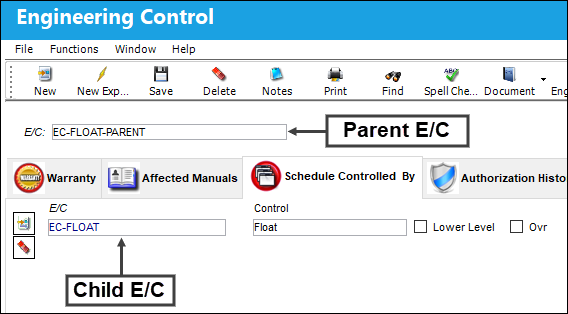
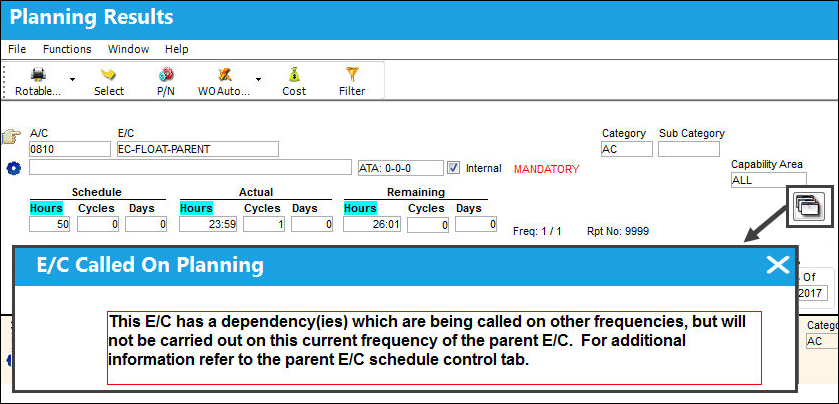
The Float control is similar to the Called On control, however the float control relies on a formula instead of a set frequency number to determine when the child E/C will follow the parent E/C. It is designed to combat the loss of potential child E/C yields due to the constraints of the set frequency.
The system will force a parent E/C to call on its child E/C when the following formula holds true:

If this formula does not apply to the current instance of the parent E/C, the child E/C will not be called onto that particular instance.
Note: P/N E/Cs can be called on by aircraft E/Cs (where the aircraft E/C acts as the driving E/C), but aircraft E/Cs can not be called on by P/N E/Cs (where the P/N E/C acts as the driving E/C).
This control may be utilized multiple times to set up an unlimited number of parent/child E/C relationships.
The following information/options are available in this window:
_____________________________________________________________________________________
Lower Level checkbox
When this checkbox is selected it indicates that all of the task card steps for the child E/C are contained within the parent E/Cs task card. When the parent E/C is added to a work order, the child E/C follows but any task cards related to the child E/C will not be attached to the work order.
 Do not select this checkbox if the child E/C task cards are to be attached to the work order.
Ovr checkbox (Override checkbox)
This checkbox is not in use; it was designed for a specific customer.
_____________________________________________________________________________________
Float example 1:
Using the above parent/child E/C relationship, note the parent and child E/C schedules and remaining times from the planning results.
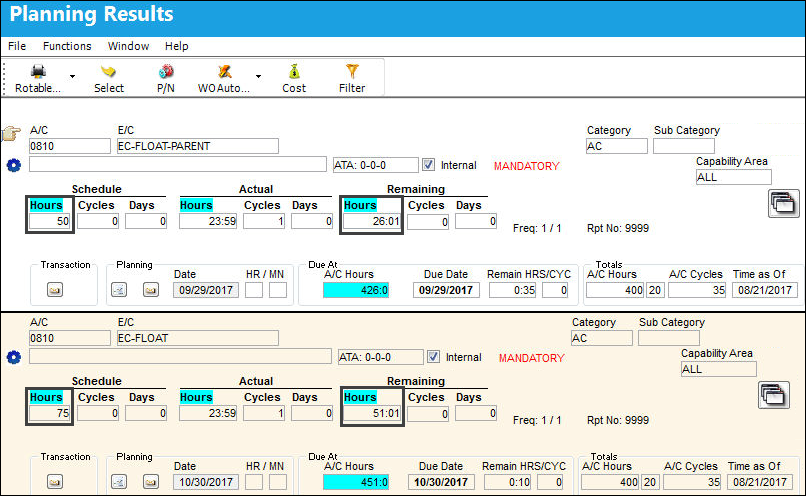
Using the formula, substitute the variables for the values shown above to determine whether or not the child E/C should be called on by the parent E/C.

Since the sum of the remaining time and the next scheduled time for the parent E/C (76:01) is greater than the remaining time on the child E/C (51:01), the formula applies. The parent E/C will call on the child E/C.
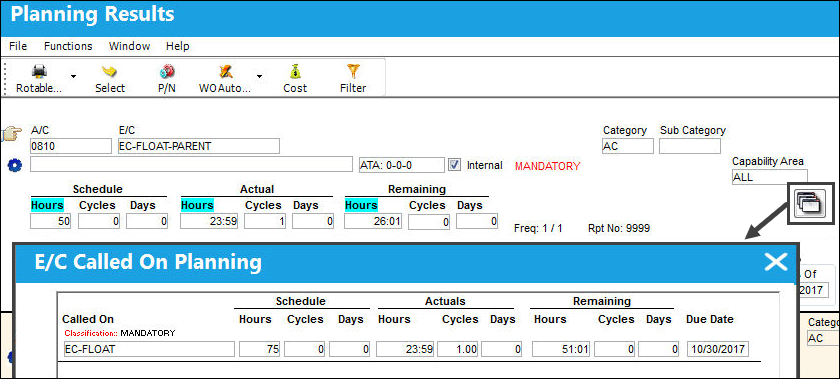
Float example 2:
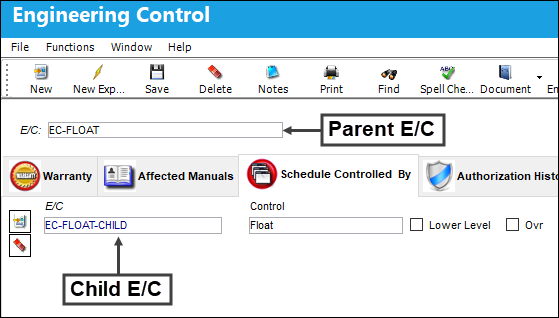
Using the above parent/child E/C relationship, note the parent and child E/C schedules and remaining times from the planning results..
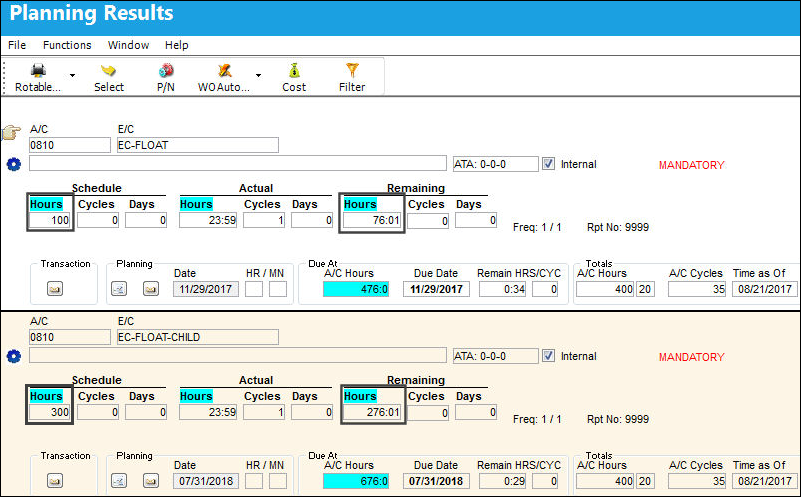
Using the formula, substitute the variables for the values shown above to determine whether or not the child E/C should be called on by the parent E/C.

Since the remaining time on the child E/C (276:01) is greater than the sum of the remaining time and the next scheduled time for the parent E/C (176:01), the formula does not apply. The parent E/C will not call on the child E/C.
Share
Print
|
©1997-2026 Trax USA Corp. All rights reserved. This manual may not be copied, photocopied, reproduced, translated, or converted to any electronic or machine-readable form, in whole or in part, without prior written approval from Trax USA Corp. |
 |