
 Share
Share
 Print
Print
|
|
|
|
|


Task Card Authorization Explorer
The Task Card Authorization Explorer allows the user to review, reserve, accept, and/or reject Task Cards that have been released for authorization. The authorization process can be as simple as a one step authorization, or as complex as the user would like, such as a five or ten step authorization process. The actual authorization configuration process is user-defined based upon each users' individual business process needs, and can be set up via the Task Card Category (Engineering) System Transaction Codes.
In order to use the Task Card Authorization Explorer, Switch  REVAUTH must be set to Yes. When this switch is set to Yes, an authorization will be required for all Task Cards initially created and revised. These Task Cards will be placed in the Task Card Authorization Management queue to be released and/or accepted. If the users' business process does not include accepting Task Cards via Task Card Authorization Management, then the task Card will be accepted in the Task Card Authorization Explorer.
Once a Task Card has been released for authorization via Task Card Authorization Management option, go to Engineering/Explorer/Task Card Authorization.
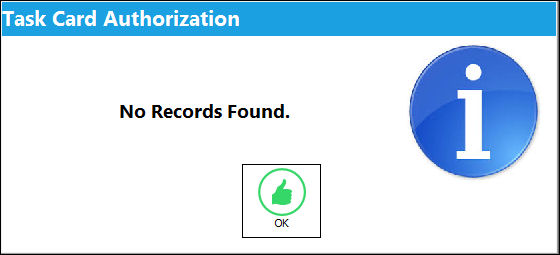
If no Task Cards are currently awaiting authorization, or there are no Task Cards pending authorization that fit the user's criteria based upon the set up of the Task Card Category (Engineering) System Transaction Code, the following message will appear:
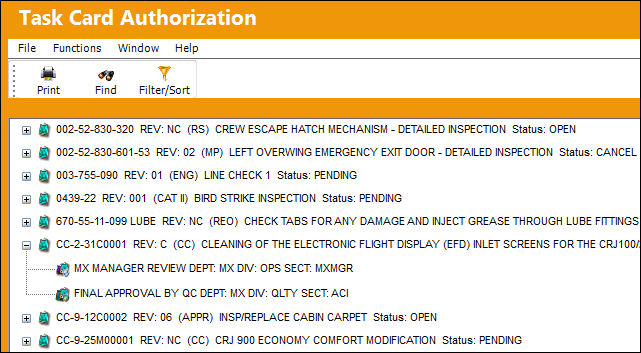
When entering the Task Card Authorization Explorer, TRAX will display the following screen:
In the above example, the status of the Task Card Revision Authorization is as follows:
Authorization Step 001 has been Accepted.
Authorization Step 002 is the current Authorization Step pending acceptance
Authorization Steps 003, 004 and 005 are all pending Authorization Step 002 being accepted.
In the Task Card Authorization process, there are no Parallel or Parent Child Authorization Steps, so steps must be accepted in order, for example Authorization Step 001, followed by 002, then 003 and so on, until all the Authorization Steps have been accepted.
Authorization Steps can be configured in the Task Card Category (Engineering) System Transaction Code to be accepted by a user that meets the Department, Division and Section or Authorization Group criteria that is set up. This is a user defined configuration based upon the business requirements of the customer. For additional information regarding Authorization Groups, refer to Task Card Category (Engineering) System Transaction Code.
Task Card  icon
icon
This is a Task Card that is pending authorization. This information includes Task Card Number, Task Card Revision, Task Card Description and Task Card Category. This line will also show the status of the revision. By selecting into the Task Card, the Task Card detail can be viewed in Query Mode if required.
Current/Pending Step  icon
icon
The current open Task Card Authorization Step(s) that is pending acceptance. These steps can be viewed in Query Mode after being accepted if required.
Accepted Status  icon
icon
A Task Card Authorization Step that has been accepted. These steps can be viewed in Query Mode if required.
Upcoming Status  icon
icon
A Task Card Authorization Step that is pending prior steps to be accepted. These steps cannot be accepted until the prior step(s) have been accepted. These steps can be viewed in Query Mode if required.
Reserved  icon
icon
The reserved icon appears when a step has been reserved and the Reserved checkbox has been selected.
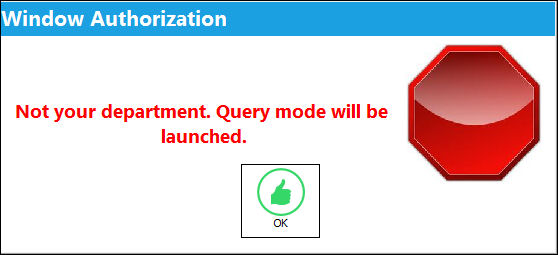
When in the Task Card Authorization Explorer window and attempting to access and authorize a step that is not configured for the department or group that the user belongs to, the user cannot Accept or Reject the step. The user may only view the Authorization Step in Query Mode due to the Task Card Category configuration stipulating that another department is set up to authorize this specific step. TRAX will display this query only warning message and allow the user to enter the Authorization Step only to view the information:
When initially entering the Task Card Authorization Explorer window to accept the first Authorization Step, TRAX displays the following screen:
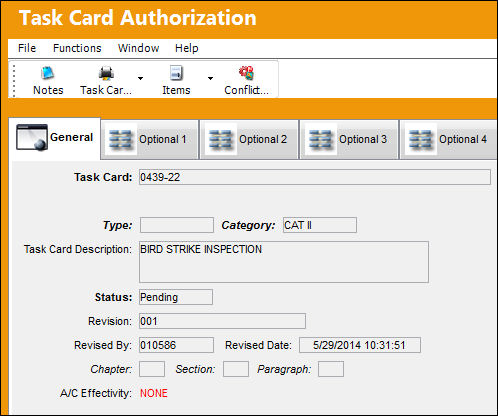
By right-clicking on the Task Card , the related Task Card Authorization window is displayed. This allows the user to review the Task Card Detail and make any final revisions to the Task Card, if required.
To authorize the first Step, the user needs to select the Authorization Step.
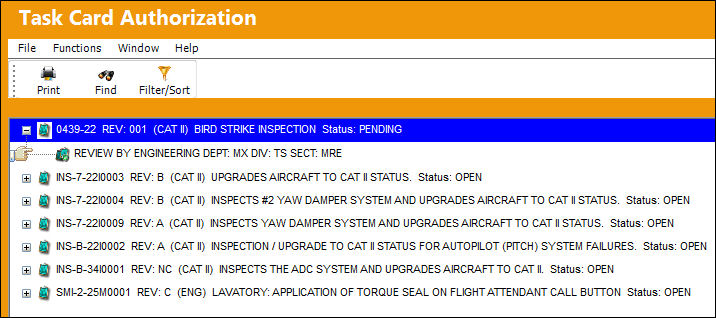
When the user selects the Authorization  option, TRAX displays the Task Card Authorization window for this authorization step:
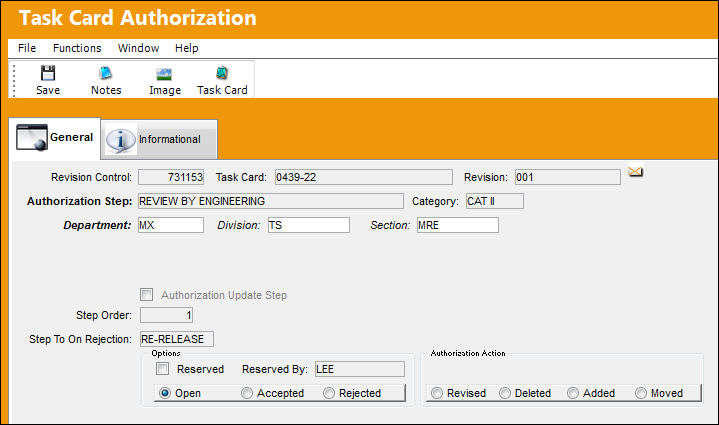
The following information/options are available in this window:
_____________________________________________________________________________________
Revision Control
Automatically generated control number for each revision step.
Category
The Task Card's Category, as defined in Task Card Category transaction code via the Engineering Transaction Codes. Task Card Authorization Steps are defined in System Transaction Codes by Task Card Category.
Authorization Step
A description of the Authorization Step; each Authorization Step can have its own unique description to describe the steps general purpose.
Department
The department which has authority for approval of this step. The Authorization Step can only be performed by an individual in the department specified here. See Settings/ Update/ Employee Master to verify that the employee is assigned to the appropriate department. Authorizing employees must have security access to the appropriate Authorization Explorer option. When this field is left blank, the Authorization Group field is available.
Division
The division which has authority for approval of this step. The Authorization Step can only be performed by an individual in the division specified here.
Section
The section which has authority for approval of this step. The Authorization Step can only be performed by an individual in the section specified here.
Authorize Update Step checkbox
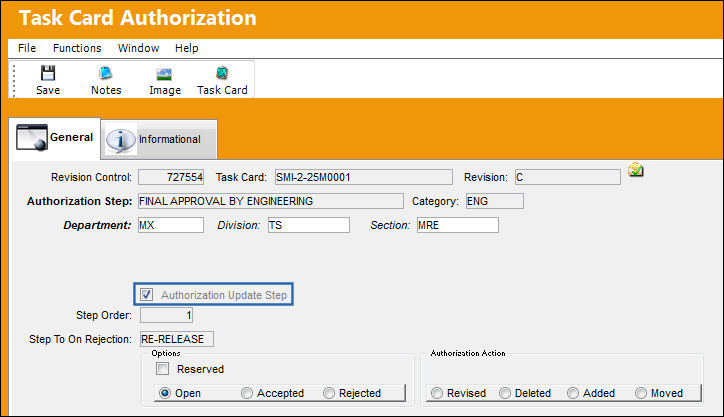
When selected, the checkbox indicates that the current Authorization Step will be the last step in the authorization process. During the creation of the Authorization Steps, this checkbox should only be selected for the final step before the record is to be released from authorization.
Step Order
This number indicates the order of Steps if one or multiple Steps are created. This number is automatically created and can be overridden and changed to any number. It is recommended that the user enter Steps in a standard incremental pattern (i.e. Step 5, Step 10, Step 15, etc.) to allow for the insertion of Steps into the sequence at a later time if required.
Step To On Rejection
This indicates how the Authorization Process will react when a Step is rejected (Start, Return To, Re-Release). When an authorization Step has been rejected, the Step To On Rejection process begins based on the configuration of the Task Card Category System Transaction Code.
Start - Will return the Authorization Process to the first step.
Return To - Will return the Authorization Process to a specific Authorization Step as specified by the 'Return To' Step number in the Return To Step Order field.
Re-Release - Will return the Authorization Process to the queue where it will await Release For Authorization.
Reserved
This allows a user to reserve the step. This will lock that user into that specific authorization step and does not allow another user to accept the step. The name of the user who Reserved the Authorization Step will appear in the Reserved By field.
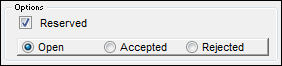
Open radio button - All authorization steps are initially in Open status, until either Accepted or Rejected. A step can also be Open and Reserved at the same time.
Accepted radio button - This option is selected when the user accepts the authorization step.
Rejected radio button - This option is selected when the user is rejecting the Authorization Step when there are reasons that do not permit the step from remaining open or being accepted. The Rejection Reason field is mandatory upon the Authorization Step becoming Rejected.
When a step has been reserved, the Reserved icon will appear next to it.
Rejection Reason
A Rejected Reason must be entered when Rejecting an Authorization Step. An authorization Step can be Rejected and Reserved at the same time so that when the authorization process comes back to that specific step, the same person who rejected it will have to authorize that same previously. This is especially beneficial due to the original person who rejected the step knowing first hand why it was rejected.
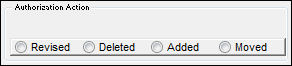
Authorization Action
Select any of the below authorization actions. These actions will be recorded in the Revision History tab of Task Control.
For additional information refer to Task Card, Revision History Tab via Engineering Control which can be found in the Engineering Training manual.
Revised radio button - This is informational only.
Deleted radio button - This is informational only.
Added radio button - This is informational only.
Moved radio button - This is informational only.
_____________________________________________________________________________________
To accept this Task Card Authorization step, select the Accept radio button and select the Save  button. TRAX will refresh and display the Task Card Authorization Explorer window with Authorization Step 001 Accepted and Authorization Step 002 pending.
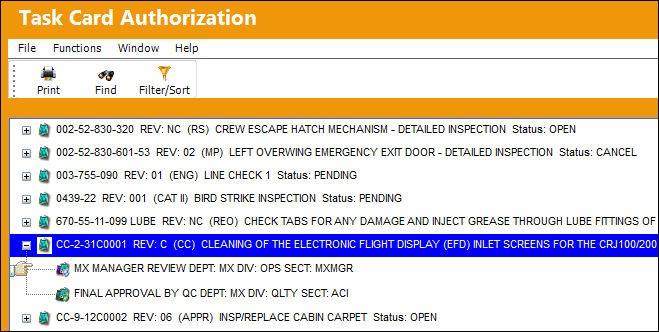
Task Card Authorization Step 002 is now on top and Authorization Step 001 is the second step in the window. The pending Authorization Step is always on top.
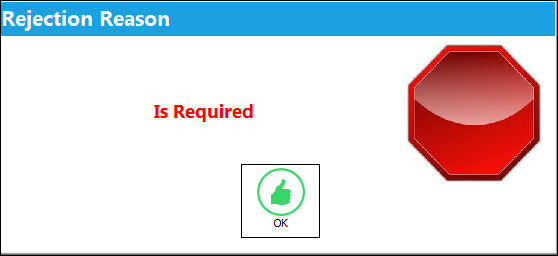
To reject this Task Card Authorization Step, select the Rejected radio button and select the Save button. When rejecting an Authorization Step, the Rejection Reason field shows in the window. It is mandatory to populate the reason when rejecting an Authorization Step. The user also has the option to Reserve a Rejected Authorization Step.
If a user rejects an Authorization Step and does not enter a Rejection Reason, the following prompt will appear and a reason must be entered:
After accepting Task Card Authorization Step 001, the user can accept Task Card Authorization Step 002, and so on. When authorizing the last step, which is also the final Authorization Update Step, the user will notice that this checkbox is automatically selected. This is based on the configuration of the Task Card Category (Engineering) System Transaction Code configuration.
After selecting the Accept option for Task Card Authorization Step 005, which is also the Authorization Update Step, the system prompts the user with the following soft warning:
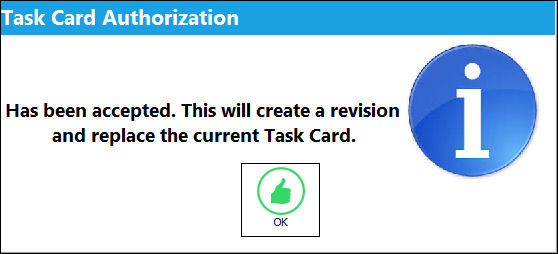
This prompt advises the user that this Task Card Revision has been fully authorized and that TRAX will create a revision and replace the current Task Card. The user then should select OK to continue.
TRAX refreshes the Task Card Authorization Explorer window and displays the Task Card, but no authorization steps are listed because all authorization steps have been accepted.
The following buttons are available for additional functionality:
- Filter/Sort Button


 Share
Print
Share
Print
|
©1997-2026 Trax USA Corp. All rights reserved. This manual may not be copied, photocopied, reproduced, translated, or converted to any electronic or machine-readable form, in whole or in part, without prior written approval from Trax USA Corp. |
 |