
 Share
Share
 Print
Print
|
|
|
|
|


Exchange Order Out, General Tab
The Exchange Order Out, General tab allows the user to access open orders created by the user and create new orders.
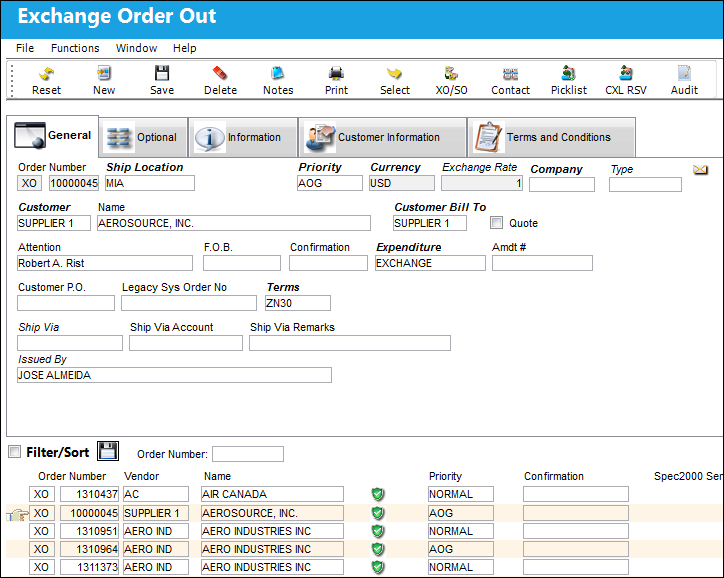
 The Order Number field can be used to filter the open orders created by the user to access a particular order.

To create an order, select the New  button. TRAX displays the Exchange Order Out, General tab, as follows:
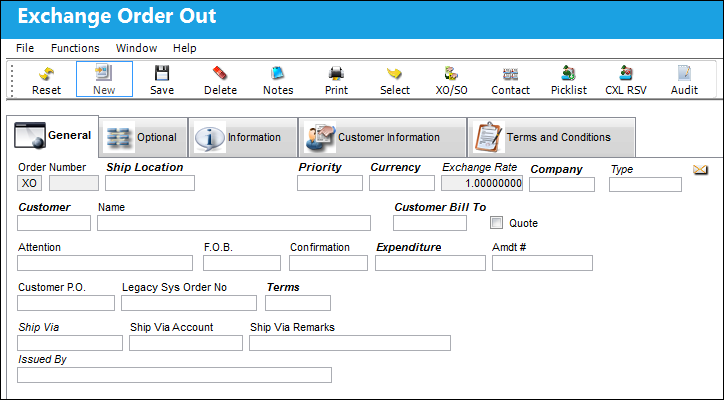
The following information/options are available in this window:
_____________________________________________________________________________________
Order (Order Type)
Type of Order. By order type, certain receiving and financial behaviors will be assigned to the order at receiving of the various Order Types. These order types exist under the Orders or Customer Orders Modules exclusively. All Order Types are Hard Coded into the programming syntax.
Number (Order Number)
An auto-generated unique sequential number is assigned to each order. All Order Types which exist under the Order Module will receive their number for the following configuration:
 POSEQ - (Orders Next Sequence Number) - Next number for an Order. The start number is set at implementation. The Config Number field is used.
Ship Location
The location from which the order's items will be shipped. For additional information, please refer to the Location Master, General Tab section of the Settings Training Manual.
Priority
The priority placed on the transaction (e.g., routine, AOG, etc.). For additional information and functionality, refer to the Priority transaction code via the Orders Transaction Codes.
Currency
The currency that will be used for the order transaction. Currencies may be defined for the Customer/Vendor in the Customer/Vendor Master and overridden at the order level. For additional information, please refer to the Currency section of the G/L Interface, System Transaction Code Training Manual.
Exchange Rate
The currency exchange rate associated with the order.
Category
The appropriate category for this transaction. This also works with the Authorization Process as defined against the Order Type.
Company
The company the order is being created for.
Note: This field appears only when G/L Interface Switch COMPANYMULTI is set to 'Yes.' This feature is part of the Multi-Company functionality. Parent company's airlines are entered into this field. Then, when the P/N is entered into the detail window, the G/L field will be auto-populated with this airline's previously created G/L Account. When the switch is set to 'No' the field is titled Category and functions as defined above. For more information see the G/L Interface Switch COMPANYMULTI via the G/L Interface Switches Manual.
Type
Exchange Order Out Type Transaction Code, to specify the type of XO. For example, 'Advanced' or 'Standard.' This is not functional, but strictly informational.
Customer
The customer the order is being placed with requiring the items.
Name
The name of the customer who was selected in the Customer field will appear here as defined in the Customer Master.
Customer Bill To
The customer bill to code (if different) or billing address.
Quote checkbox
Users can check this box if they would like to use this record strictly as a quote. The checkbox is used for informational purposes only.
Attention
Identify the intended recipient of the order. This field may be pre-defined in the Main Contact field on the Customer Master, Mailing Address tab. The main contact will default upon order creation. Additional contacts may be defined in the Vendor Master and selected against the order. For additional information, please refer to the Contact  button, via the System Standards Training Manual.
F.O.B
Freight On Board information (sometimes referred to as Free On Board). This information may be pre-defined by vendor. For additional information please refer to the Vendor Master, Shipping Information tab of the Settings Training Manual.
Confirmation
The confirmation reference along with applicable information.
Expenditure
The expenditure code for the order.
Amdt #
The amendment reference number for the order.
Customer P.O.
For Third Party purchase, if purchase is on behalf of a customer the PO number may be entered here. Additional Use - if a Sales Order is generated in the system for the service requirement, it may cross reference here as well. This is to be defined by the company procedures. This does not invoice or charge the customer for any service provided. It is only used as a reference number.
Legacy System Order Number
The legacy number related to the order. The legacy number is typically identified and used by customers during implementation to cross reference their old systems order number to the new systems order number.
Terms
The terms of payment may be defined in the Customer Master by selecting from the pre-defined listing established in the System Transaction Codes. Terms may be changed for a particular order as required. For additional information, please refer to the Terms section of the System Trans Codes Training Manual.
Ship Via
Shipping-related information. This information may be pre-defined by customer, but may be changed for a particular order, as required. For additional information please refer to the Customer Master, Shipping Information Tab of the Settings Training Manual.
Ship Via Account
Shipping-related account number. This information may be pre-defined by customer, but may be changed for a particular order, as required. For additional information please refer to the Customer Master, Shipping Information Tab of the Settings Training Manual.
Ship Via Remarks
Shipping-related notes. This information may be pre-defined by customer, but may be changed for a particular order, as required. For additional information please refer to the Customer Master, Shipping Information Tab of the Settings Training Manual.
Issued By
The employee who issued the order. If left blank, the system will consider the user who created the order as the issuer.
Open Orders graph
A pie chart displaying the amount of open orders created by the user, divided by Order Type, with the number of open orders for each type. This graph is not functional, but utilized as a reference. An example of the graph can be seen in the following: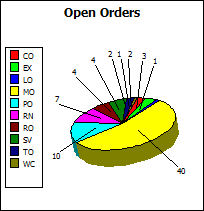
This graph is available to view with Switch HIDEORDERGRAPH set to No.
Open Orders by Priority graph
A bar graph displaying the amount of open orders created by the user, divided by Priority, for each Order Type. This graph is not functional, but utilized as a reference. An example of the graph can be seen in the following: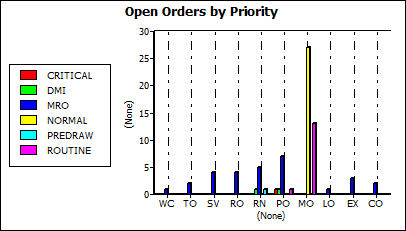
This graph is available to view with Switch HIDEORDERGRAPH set to No.
_____________________________________________________________________________________
The customer selected must be set up for the Exchange Order Out to be valid. Go to Settings/ Update/ Customer to confirm proper set up.
Share
Print
|
©1997-2026 Trax USA Corp. All rights reserved. This manual may not be copied, photocopied, reproduced, translated, or converted to any electronic or machine-readable form, in whole or in part, without prior written approval from Trax USA Corp. |
 |